koala
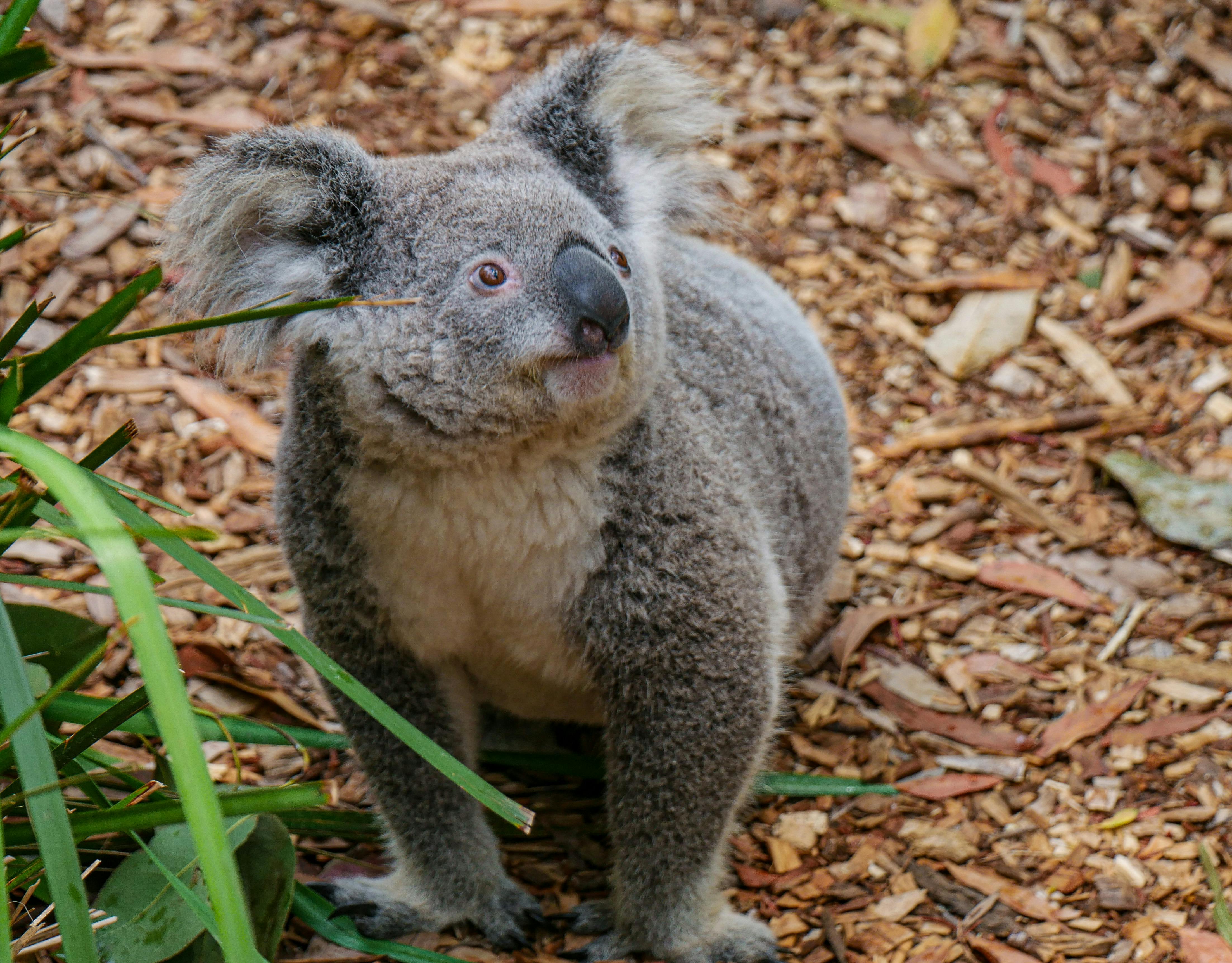
The koala (Phascolarctos cinereus), sometimes inaccurately called the koala bear, is an arboreal herbivorous marsupial native to Australia. It is the only extant representative of the family Phascolarctidae. Its closest living relatives are the wombats. The koala is found in coastal areas of the continent's eastern and southern regions, inhabiting Queensland, New South Wales, Victoria, and South Australia. It is easily recognisable by its stout, tailless body and large head with round, fluffy ears and large, dark nose. The koala has a body length of 60–85 cm (24–33 in) and weighs 4–15 kg (8.8–33.1 lb). Its fur colour ranges from silver grey to chocolate brown. Koalas from the northern populations are typically smaller and lighter in colour than their counterparts further south. These populations are possibly separate subspecies, but not all researchers accept this.
Koalas typically inhabit open Eucalyptus woodland, as the leaves of these trees make up most of their diet. This eucalypt diet has low nutritional and caloric content and contains toxic compounds that deter most other mammals from feeding on them. Koalas are largely sedentary and sleep up to twenty hours a day. They are asocial; only mothers bond to dependent offspring. Adult males communicate with bellows that intimidate rivals and attract mates. Males mark their presence with secretions from scent glands located on their chests. Like other marsupials, koalas give birth to young known as joeys at a very early stage of development. They crawl into their mothers' pouches, where they live for their first six to seven months. They are fully weaned around a year old.
Koalas have few natural predators and parasites, but are threatened by pathogens such as Chlamydiaceae bacteria and koala retrovirus. Koalas are listed as a vulnerable species by the International Union for Conservation of Nature. Among the many threats to their existence are habitat destruction caused by agriculture, urbanisation, droughts, and associated bushfires, some related to climate change. In February 2022, the koala was officially listed as endangered in the Australian Capital Territory, New South Wales, and Queensland. They are however over-abundant in parts of South Australia and Victoria, with population growth at unsustainable levels.
Because of their distinctive appearance, koalas, along with kangaroos, are recognised worldwide as symbols of Australia. They were hunted by Aboriginal Australians and depicted in myths and cave art for millennia. The first recorded encounter between a European and a koala was in 1798, and an image of the animal was published in 1810 by naturalist George Perry. Botanist Robert Brown wrote the first detailed scientific description in 1814 although his work remained unpublished for 180 years. Artist John Gould illustrated and described the koala, thereby introducing the species to the British public. Further details about the animal's biology were revealed in the 19th century by English scientists.
Etymology
The word "koala" comes from the Dharug gula, meaning 'no water'. Although the vowel "u" was originally written in the English orthography as "oo" (in spellings such as coola or koolah—two syllables), the spelling for that sound later became "oa"; the word is now pronounced in three syllables (ko-a-la) possibly in error based on that new spelling.[4] Another hypothesis is that "koala" was an aboriginal name from the Hawkesbury River district near Sydney.[5]
Adopted by white settlers, the word "koala" became one of hundreds of Aboriginal loan words in Australian English, where it was also commonly referred to as "native bear",[6] later "koala bear", for its resemblance to a bear.[7] It is one of several Aboriginal words that made it into International English alongside words like "didgeridoo" and "kangaroo".[7]
The koala's generic name, Phascolarctos, is derived from the Greek words φάσκωλος (phaskolos) 'pouch' and ἄρκτος (arktos) 'bear'. The specific name, cinereus, is Latin for 'ash coloured'.[8]
Taxonomy
The generic name Phascolarctos was given in 1816 by French zoologist Henri Marie Ducrotay de Blainville,[9] who did not give it a specific name until further review. In 1819, German zoologist Georg August Goldfuss gave it the binomial Lipurus cinereus. Because Phascolarctos was published first, according to the International Code of Zoological Nomenclature, it has priority as the official genus name.[10]: 58–59 French naturalist Anselme Gaëtan Desmarest coined the name Phascolarctos fuscus in 1820, suggesting that the brown-coloured versions were a different species than the grey ones. Other names suggested by European authors included Marodactylus cinereus by Goldfuss in 1820, P. flindersii by René Primevère Lesson in 1827, and P. koala by John Edward Gray in 1827.[2]: 45